How can you Upskill with AI for your CMA USA Journey?
 By IIC Lakshya
 03 Feb 2026

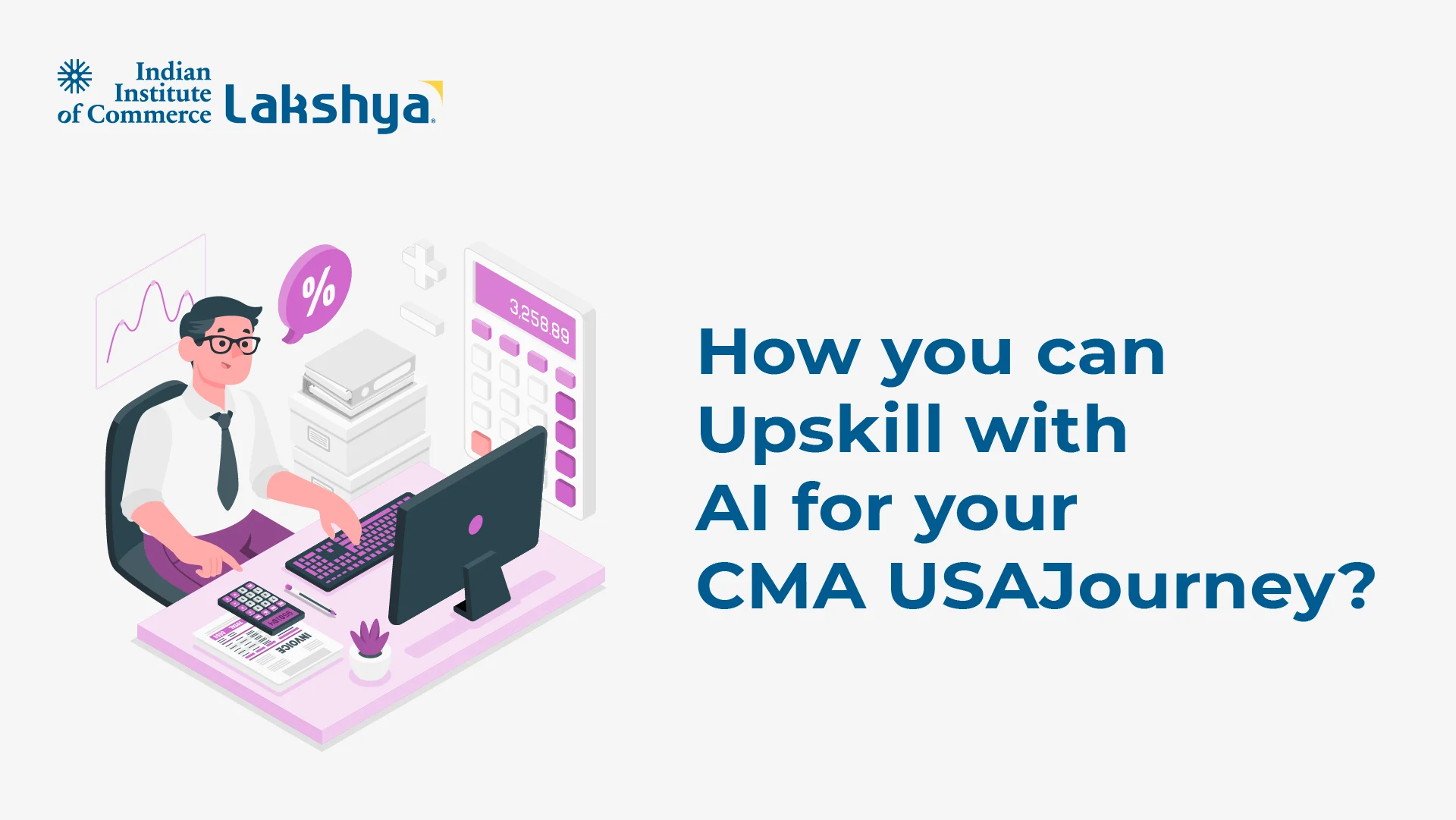
The CMA USA (Certified Management Accountant) qualification is built around decision-making, performance management, and strategic financial leadership. As businesses increasingly rely on data, automation, and intelligent systems, Artificial Intelligence (AI) is becoming deeply integrated into the very roles CMAs aspire to hold. Upskilling with AI during your CMA USA journey is no longer an added advantage, it is fast becoming a career necessity.
AI does not replace the core principles of management accounting. Instead, it strengthens a CMA’s ability to analyze data, forecast outcomes, evaluate performance, and support strategic decisions. Learning to work alongside AI during your CMA preparation prepares you for both the exams and the evolving corporate finance landscape.
Why AI Skills Are Important for CMA USA Aspirants?
The CMA USA curriculum focuses heavily on planning, control, analysis, and strategic management, areas where AI is already widely used in real organizations. Companies today use AI-powered tools for budgeting, forecasting, cost optimization, variance analysis, and performance dashboards.
For CMA aspirants, AI skills help bridge the gap between theory and practice. They enhance:
- Analytical thinking
- Business interpretation of financial data
- Speed and accuracy in decision support
-
Strategic insight backed by data
A CMA with AI awareness is better equipped to move into FP&A, finance management, and leadership roles.
Using AI to Strengthen CMA Part 1 Preparation
CMA Part 1: Financial Planning, Performance, and Analytics aligns extremely well with AI-driven finance functions. AI can be used to make preparation more effective and application-oriented.
AI helps aspirants by:
- Explaining budgeting, forecasting, and variance analysis with practical examples
- Simulating cost-volume-profit and performance scenarios
- Breaking down complex analytics concepts into simple logic
-
Generating practice questions based on real business cases
This allows candidates to move beyond rote learning and develop decision-focused understanding, which is essential for CMA success.
AI in Cost Management and Performance Analysis
Cost management is one of the strongest pillars of the CMA syllabus. In real-world organizations, AI is already used to:
- Identify cost inefficiencies
- Analyze cost drivers
- Optimize resource allocation
-
Predict future cost behavior
By learning how AI supports cost analysis, CMA aspirants develop a more practical and industry-aligned mindset, making it easier to handle exam scenarios and workplace challenges.
AI for CMA Part 2: Strategic Financial Management
CMA Part 2 focuses on strategy, financial decision-making, risk management, and investment analysis, all areas where AI plays a growing role.
AI can support CMA Part 2 preparation by:
- Simplifying complex capital budgeting decisions
- Explaining risk assessment and financial modeling
- Simulating strategic decision scenarios
-
Connecting financial metrics with long-term business strategy
Understanding AI-supported strategy helps candidates think like future finance leaders, not just exam candidates.
AI and Financial Analytics: A Natural Fit for CMAs
Analytics is a core theme of the CMA qualification, and AI enhances analytics by:
- Processing large datasets
- Identifying patterns and trends
- Supporting predictive analysis
-
Improving performance measurement systems
CMA professionals who are comfortable with AI-driven analytics are highly valued in FP&A, business intelligence, and corporate strategy roles.
How to Build AI Skills for Corporate Finance Careers?
Upskilling with AI during your CMA journey prepares you for real corporate environments where finance teams:
- Use dashboards instead of static reports
- Rely on predictive models instead of historical-only analysis
-
Support management decisions with data-backed insights
CMAs who understand AI concepts can communicate more effectively with data teams, management, and leadership, making them strategic partners rather than just number specialists.
AI Enhances the CMA Role,It Doesn’t Replace It
AI can process data, but it cannot replace:
- Professional judgment
- Ethical responsibility
- Strategic thinking
-
Business context understanding
These are core strengths of a CMA. AI simply amplifies them. By learning AI alongside CMA, aspirants ensure their skills remain future-proof and leadership-oriented.
How to Start AI Upskilling During Your CMA USA Journey?
CMA aspirants can start AI upskilling by:
- Understanding basic AI and analytics concepts
- Learning how AI is applied in budgeting, forecasting, and performance management
- Using AI tools to support learning and case analysis
-
Staying updated on how finance roles are evolving with technology
The goal is not to become a technical expert, but a tech-aware management accountant.
Why CMA USA + AI Is a Powerful Combination?
CMA USA builds strong foundations in financial strategy and management. AI adds speed, depth, and data-driven confidence. Together, they create professionals who can:
- Interpret numbers with business insight
- Support management with actionable recommendations
-
Lead finance functions in technology-driven organizations
This combination significantly enhances career growth and long-term relevance.
Learn More
FAQs on AI Upskilling for CMA USA Aspirants
Is AI knowledge required to clear CMA USA exams?
No, but AI helps improve understanding and application of CMA concepts, especially analytics and strategy.
Do I need a technical background to learn AI for CMA?
No. CMAs need conceptual understanding and application, not programming skills.
Does AI help more in CMA Part 1 or Part 2?
AI is useful for both, but especially powerful in Part 1 (analytics and performance) and Part 2 (strategy and decision-making).
Will AI skills improve CMA career opportunities?
Yes. AI-aware CMAs are better suited for FP&A, corporate finance, and leadership roles.
Related Course

































_11zon.webp)













.webp)
.webp)

.webp)
.webp)
.webp)
.webp)
.webp)
.webp)
.webp)







































































































































.webp)
















 salary.jpg)



.webp)

.webp)
.webp)