IAS vs IFRS Comparison: What Companies Need to Know
 By IIC Lakshya
 21 Nov 2025
 Others
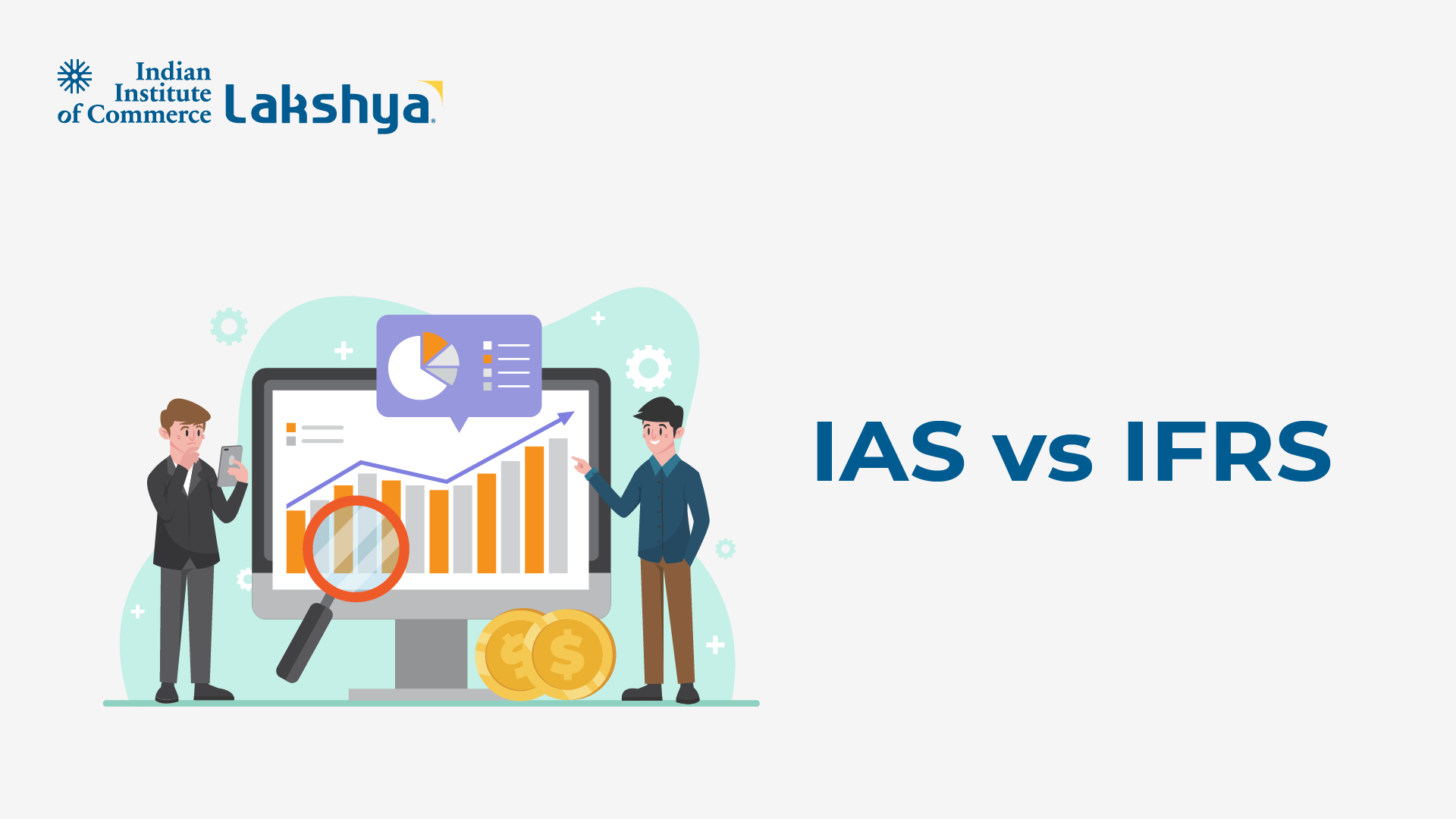
Do you want to learn about the difference between IAS and IFRS but don’t know where to start? In finance and accounting reporting, IAS and IFRS play a significant role and often come up when discussing the rules and guidelines implemented by companies to develop financial statements based on their financial performance. Let’s explore the terms, their differences, and how they work together.
What is IAS?
The full form of IAS is International Accounting Standards, which was published by the International Accounting Standards Committee (IASC). The IASC developed and introduced IAS standards in the year 1973, and it is the foundation on which other Financial Reporting Standards have been developed.
With various career options in Finance, knowing how to implement IAS and IFRS in companies is a skill. IAS was a step towards establishing the global accounting standards, leading to rules and regulations guiding companies to establish their financial statements till 2001.
However, it has been replaced, though some of the effective rules are still in practice. Companies combine both IAS and IFRS to create their financial statements and reports.
What is IFRS?
Later came the IFRS in 2002, and the full form of IFRS is International Financial Reporting Standards, which is the successor of IAS. These standards are a set of accounting which are published by the International Accounting Standards Board (IASB). They are more flexible and accommodating when it comes to the future financial scope of companies.
So, why are these standards necessary? Global companies across the world can compare their financial information and performance by implementing IFRS standards. It also helps companies to learn the potential impact and future decision-making related to finance. Read the article about the eligibility for IFRS certification, on how to apply for the certification.
Students pursuing the DipIFR course will learn about these standards. They can effectively implement their knowledge into their professional practices when employed in an organisation.
Key Differences between IAS vs IFRS
Below is a tabular form identifying the key differences between IAS and IFRS. These differences will guide you through the changes that have been implemented after IFRS replaced the IAS. You can learn about these differences when you pursue IFRS courses, thus understanding the IFRS salary guide.
|
Key Features |
International Accounting Standards (IAS) |
International Financial Reporting Standards (IFRS) |
|
Authority Body |
International Accounting Standards Committee (IASC) |
International Accounting Standards Board (IASB |
|
Active Time Period |
Issued in 1973 and practised till 2001 |
Practised after 2001 and continuing till the current date |
|
Approach |
Based on specific rules Prescriptive |
Based on principles Flexible |
|
Current Status |
Some older IAS standards are still practised In most cases, the IFRS supersede most IAS rules |
The present and active set of rules and principles of International standards |
|
Scope |
The IAS standards have a narrowed coverage and range when it comes to resolving accounting issues for organisations |
The IFRS covers a wide range of accounting issues of organisations as it helps with more detailed requirements |
How do IAS and IFRS Integrate in Real Companies Together?
Technically, IAS and IFRS are different; however, both are used by companies across the world. Several globally listed organisations use both IAS, an older standard, and IFRS, the replacement standard. Students of the diploma in IFRS ACCA have the scope of working in these companies in the future. The names of the companies are below:
- HSBC
- Nestle
- Vodafone
- Unilever
- Siemens
- Adidas
The IAS standards are still very relatable for companies when it comes to handling foundational areas like impairment (IAS 36), inventory management (IAS 2), provisions (IAS 37), and PPE (IAS 16). While IFRS standards effectively handle complex areas that are modern and relatable to recent organisational changes.
These complex aspects of an organisation are financial instruments (IFRS 9), revenue (IFRS 15), insurance (IFRS 17), and leases (IFRS 16). You can learn about these resources in detail in the IFRS course and syllabus. Implementing both these standards whenever necessary helps companies to integrate transparency and accountability. It helps them shape all major financial numbers in their financial statements and reports.
Why are IAS and IFRS Integral to Corporate Reporting?
Both the IAS and IFRS are integral to Corporate Reporting because they help shape the financial story of an organisation. Investors learn about a company’s performance as the integration of IAS 16 - asset valuation, IFRS 15 - Revenue patterns, and IFRS 16 - debt recognition creates the perfect financial picture.
The two financial reporting standards also influence the way an organisation makes its strategic decisions. When companies implement IFRS 16, they learn how much they can invest in their growth and development. Additionally, companies learn about the economic reality of the market with the implementation of IFRS 9.
It helps companies to check their future profit or credit losses, thus making a more specific risk report. Investors and their decision about a company is based on the implementation of IAS 36, which reflects impairment tests. Henceforth, these are the benefits of a diploma in IFRS, as the health of future earnings, potential, and assets can be evaluated.
Significance of IAS vs IFRS
In conclusion, when comparing the IAS and IFRS standards, there are some technical differences; both of them help companies keep transparent financial performance and information. In this article, you get a detailed evaluation of how both IAS and IFRS are significant for companies because they establish financial reporting standards.
Read More
- FRM vs CFA: Which is Better for Quant in Finance?
- How AI-Powered ERP Systems Are Transforming Corporate Finance?
- Global Finance Trends & their Career Impact
- Emerging Finance Careers in 2025: Every Professional Should Know
- Top 10 Skills Finance Professionals Must Build Beyond Degrees
Frequently Asked Questions on IAS vs IFRS
What is the IFRS checklist?
An IFRS checklist outlines the necessary steps and minimum disclosure requirements for Interim financial reporting, IAS 34. Furthermore, other IFRS accounting standards are also significant for this checklist.
Which country doesn’t follow IFRS?
The countries which does not follow IFRS are China, the United States, Egypt, Niger, Japan, and other countries.
What are the 3 main financial statements?
The three main financial statements that are significant for companies and traders are the balance sheet, statement of cash flows, and income statement.
What are the 4 principles of GAAP?
The four fundamental principles of GAAP ensure that reliability and consistency are revenue recognition, matching, cost, and full disclosure principles.
Is IFRS compulsory in India?
No, IFRS is not compulsory in India, as several companies in the country do not adopt or need to adopt the IFRS. However, some industries must adopt IFRS, like insurance, banks, and other investment financial companies.
Related Course
























































_11zon.webp)























.webp)
.webp)

.webp)
.webp)
.webp)
.webp)
.webp)
.webp)
.webp)







































































































































































































































































































































.webp)









































 salary.jpg)






.webp)

.webp)
.webp)