Risk Management for Entrepreneurs
 By IIC Lakshya
 04 Nov 2025

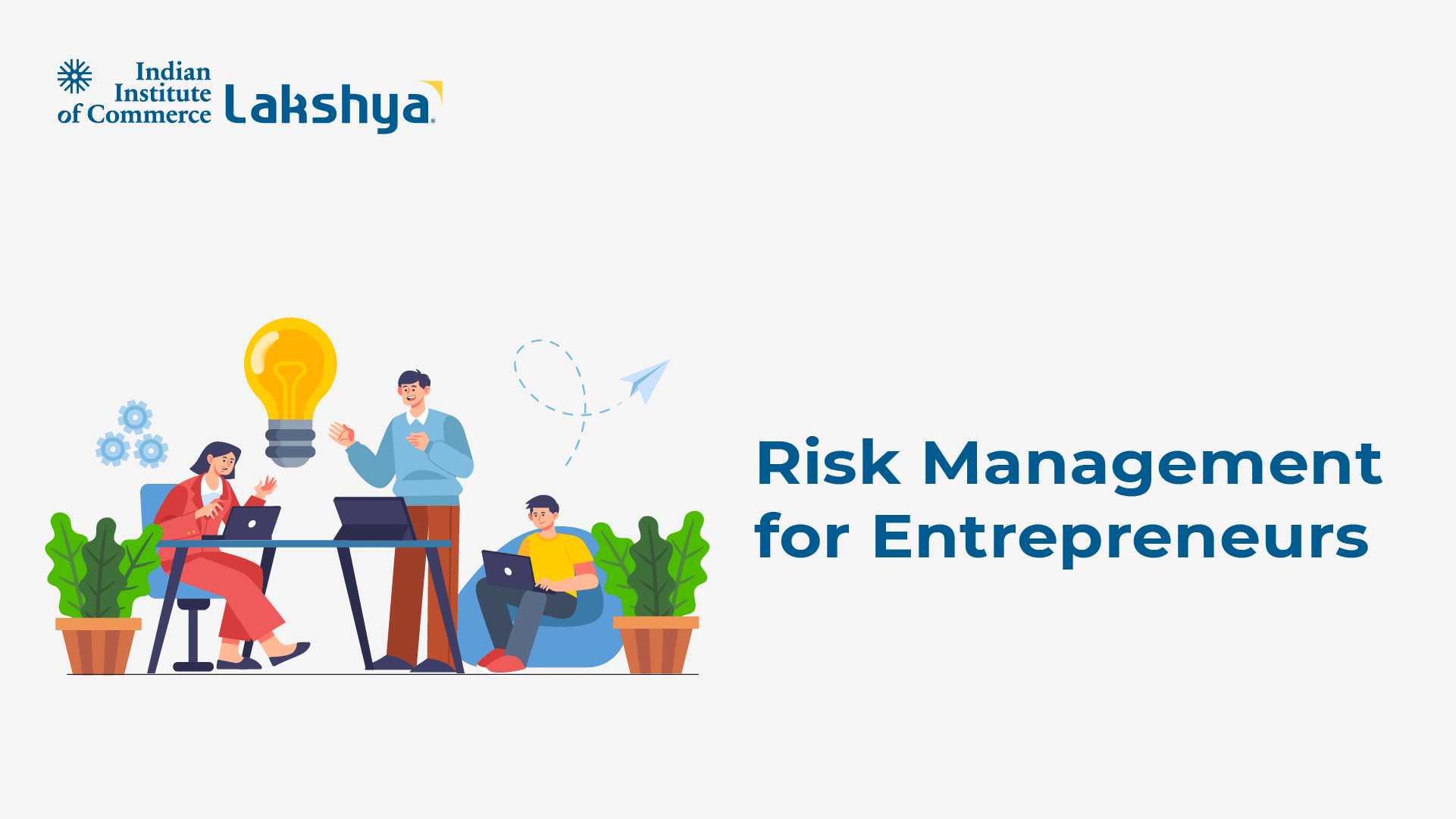
Business is an exciting venture to start up; however, there is also a risk factor attached to every entrepreneurial venture. The uncertainty is ever present, whether in terms of financial loss, competitiveness in the market or whether in terms of supply chain, or even change in consumer behavior. This is where risk management will be the most crucial tool to the entrepreneur. It does not mean risk avoidance, but that risks should be identified, evaluated, and reduced in a strategic manner. In the modern fluid world economy, the ability to comprehend the techniques of dealing with risk may be what distinguishes between a business that falls under pressure and one that succeeds despite the setbacks.
What is Risk Management in Entrepreneurship?
Risk management in a simplistic context is the act of foreseeing the possible challenges before they arise and coming up with mechanisms to mitigate the effects in entrepreneurship. The risks may be of several types to the entrepreneurs; they may be financial, operational, legal, technological, or even reputational.
As an example, a startup that has released a new product risks the failure to be received well by the market. On the same note, an online business can be subject to cybersecurity threats. Getting these possibilities analyzed beforehand, an entrepreneur is able to develop contingency plans, invest wisely and make sure that a single error will not ruin the whole project.
What are the Risks for an Entrepreneur?
The first step to effective management of risks is to understand the kind of risks:
- Financial Risk: A high amount of debt, unstable cash flow, or absence of investment can be the cause of death of a startup.
- Market Risk: The demand for a product can be diminished due to the shift of the consumer taste, the appearance of new competitors, or global events.
- Operational Risk: This can be caused by bad internal systems, lost supply channels, or ineffective workers, which will impede growth.
- Legal and Compliance Risk: Lack of adherence to the regulations, payment of taxes, and safeguarding intellectual property may result in punishment.
- Strategic Risk: When using the wrong business choices, like miscalculating the target audiences or expanding at the wrong time, it may go wrong.
The entrepreneurs can find the most relevant risks to their business model and therefore focus on the most critical ones in the first stages.
The Risk Management Process
Risk management does not happen in a vacuum: it is a cyclical process. These are the four steps that can be undertaken by the entrepreneurs:
- Identify Risks: Enumerate all the threats that might occur to your business including internal as well as external threats.
- Assess and Prioritize: Decide what risks are the most likely ones to happen and which ones may have the most significant consequences.
- Develop Mitigation Strategies: Develop action plans, like supplier diversification, insurance, or emergency funds.
- Monitor and Review: Monitor the risks as your business continues to change. New risks are usually introduced with new opportunities.
As an illustration, in the international expansion a business has to reevaluate its financial, legal, and cultural risks once again.
Commerce and Finance Knowledge and the Role of Risk Management
There is strong tendency that entrepreneurs who have studied a course in commerce education, such as those undertaking a CMA, an ACCA, or a course related to finance, have an evident advantage in risk management. They know how to interpret financial reports, project cost, and ratio analysis to find out red flags in early stages.
The financial literacy can enable business owners to identify trends that other people may miss -like irregularities in the cash flows or unsustainable debt levels. These lessons can be used to make proactive decisions and avert crisis in the business even before they occur.
How to create a Risk-resilient Startup?
Nobody has ever reached the point of entrepreneurship without having an element of uncertainty, but handling that uncertainty is what is the difference between successful business and failed ones. Entrepreneurs can convert risks to opportunities by incorporating economic knowledge, financial discipline, and forward-looking. Risk management is not merely about loss prevention but it is about making a business so robust to thrive even in a difficult situation.
Thrive to teh main component amd t mi jouive dlomebtrepreneurdsb m risk resilieemty start up andb ene conversion for h aio main circuit mabndg
The following are some of the strategies that any entrepreneur must use:
- Do not rely on a single customer or market since this is a way of diversifying your sources of income.
- Keep a cash stock to deal with crises.
- Insure assets, employees and liabilities.
- Periodically revise contracts and legal documents to remain in compliance.
- Adopt technology and data analytics, as a way of identifying the market trends before they happen.
- Risk-resiliency does not imply that one is risk-free, rather it is prepared, informed and flexible in all circumstances.
|
Did you know? Report by CB Insights indicates that 38 percent of startups fail because they run out of cash and another 35 percent fail because they do not understand the market and both of these can be avoided through proper risk management and financial planning. |
See Also
FAQs on Risk Management for Entrepreneurs
What is the importance of risk management to entrepreneurs?
Risk management can assist an entrepreneur to anticipate possible issues, mitigate them, and make a decision, which will lead to stability and profitability in the long term.
Which tools are available to startups when it comes to risk management?
The most common tools that have been used to identify and manage the business risks are SWOT analysis, financial forecasting, insurance, and scenario planning.
- What is the role that commerce and finance courses play in risk management of business?
Cost management, budgeting and financial examination are other important skills that commerce-based courses such as CMA or ACCA impart to find, evaluate, and reduce business-related risks.
Related Course













































_11zon.webp)




















.webp)
.webp)

.webp)
.webp)
.webp)
.webp)
.webp)
.webp)
.webp)






















































































































































































































.webp)





























 salary.jpg)





.webp)

.webp)
.webp)