IFRS History & Development: Global Accounting Standards
 By IIC Lakshya
 24 Jan 2026
 ACCA
ACCA
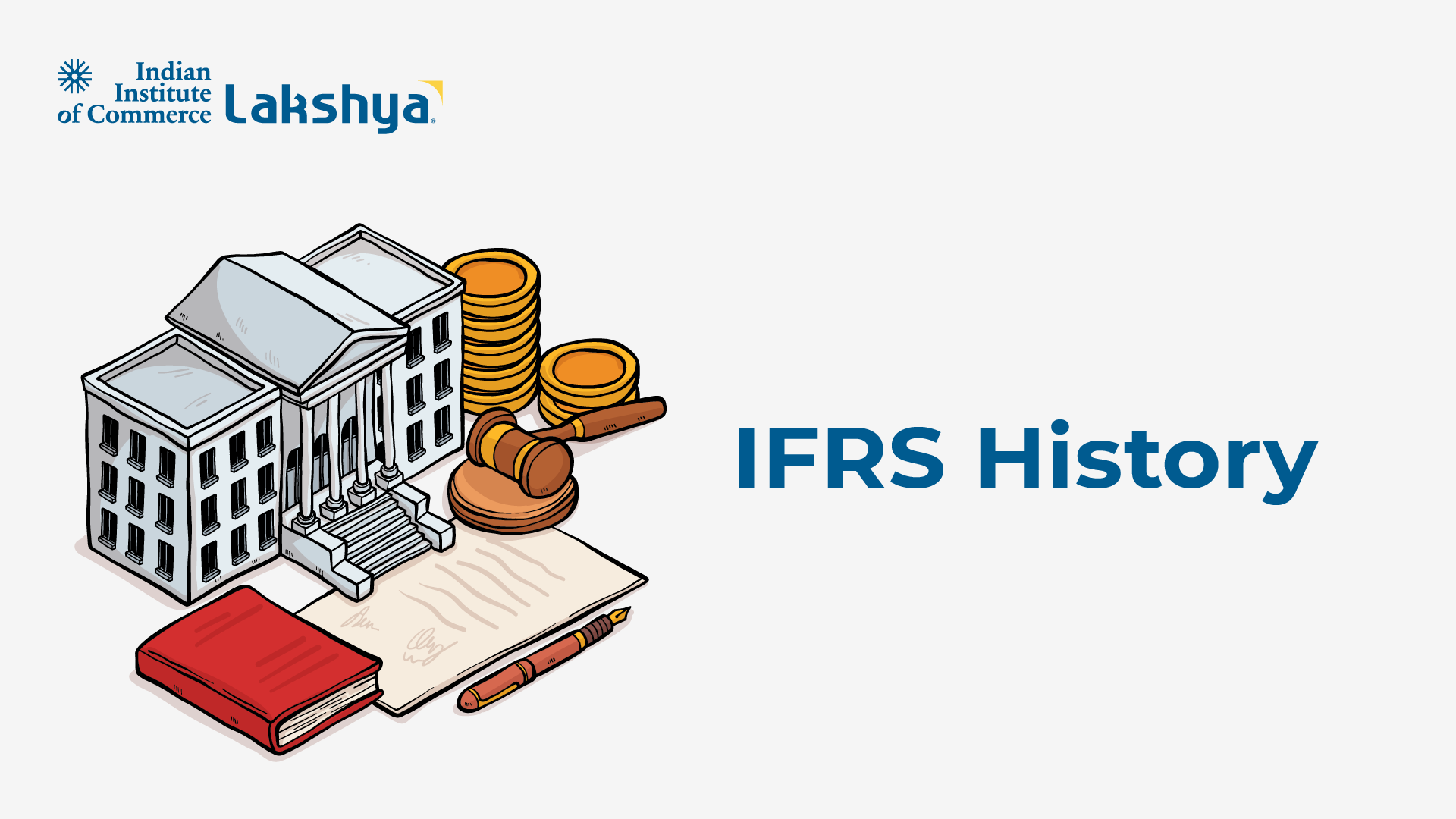
If you want to prepare for the International Financial Reporting Standards (IFRS) course exam, you must learn about the history and development of the Standards. Learning about the meaning, principles, origin, and impact will help you better prepare for the exams.
IFRS - Meaning & Principles
The full form of IFRS, International Financial Reporting Standards (IFRS), is a set of accounting standards developed, adopted, and maintained globally. These standards ensure consistency, comparability, and transparency across countries in financial reporting. You can read a complete guide on how to become an IFRS specialist.
The Standards act as guidelines for companies and the government to prepare and present the financial statements. The practice involves income statements, cash flow statements, and balance sheets. The IFRS course & syllabus also educates you about the financial accounting practices in detail.
The accounting standards are flexible as it has been converged by some countries with their Generally Accepted Accounting Principles (GAAP). Below are some of the core principles of the IFRS history:
- Accrual Basis of Accounting - all transactions are recorded effectively, as the recording is performed when the transaction occurs, instead of the sending or receiving of the cash
- Consistency - with the accurate financial statements and information reflection, the financial performance becomes more consistent among companies
- Fair Presentation - the financial statements created with the integration of IFRS represent the financial performance, position, and cash flow
- Materiality and Aggregation - the standards help in identifying the material items separately, while the immaterial items are aggregated differently
- Comparability - users get to compare the financial statements across different entities and periods
- Substance over form - transactions are accounted based on economic reality, in addition to the legal form
What is IFRS History?
The history of International Financial Reporting Standards (IFRS) goes back to 1973, which has been developed and issued by the International Accounting Standards Committee (IASC). With the implementation of IFRS, a uniform accounting Standard across the globe. ACCA qualified professionals require an in-depth understanding of IFRS.
The IASC has issued a series of standards before IFRS called International Accounting Standards (IAS). It was in 2001 that the IAS restructured itself, leading to the development and maintenance of IFRS. The integration of IFRS has led to significant growth and harmonization in global accounting standards.
Key Milestones of IFRS
IFRS contributes to the overall acceleration of global financial market growth, improved transparency, and accuracy. Candidates studying the DipIFR course also need to learn about these milestones. The significant milestones in the practices and implementation of IFRS are as follows:
|
Years |
Events taking place |
|
1973 |
The International Accounting Standards Committee (IASC) was formed by the accounting authorities of ten countries |
|
1973-2001 |
The IASC developed and published the International Accounting Standards (IAS) |
|
2001 |
The IASC restructured the International Accounting Standards (IAS) |
|
2001 |
|
|
2002 |
|
|
2005 |
|
|
2000s - Present |
|
Goals & Impact of IFRS
There are several goals of the implementation of IFRS Standards and their adoption across the globe. With the integration, it has improved the comparability level among countries and companies, ensured transparency, and boosted investor confidence. As a CA, a lot of professionals develop a better knowledge of financial accounting practices. Below are some significant impacts of the IFRS adoption and convergence:
Common Language
IFRS has become a common language across countries and companies as it is used for financial reporting. It is considered a high-quality global accounting standard that most companies follow, and some countries incorporate it with their GAAP, local Accounting Standards, such as India or Israel. You can read the implementation process of IFRS in India to better understand the impact.
Convergence
The IFRS is used by a lot of countries to draw inspiration to create their local accounting standards, which resemble it quite closely. There are countries that converge their GAAP with IFRS and regulate the companies' functioning to implement them in financial reporting and statements.
Working professionals who are certified management accountants must have expertise in the IFRS principles. As a CMA USA certified professional, candidates can access global management accounting principles through IFRS knowledge.
Global Adoption
With more than 120 countries adopting IFRS on a global scale, it can be identified as a global Standard. In financial reporting, uniformity in accounting principles on a global scale enhances the financial productivity, performance management, and confidence among stakeholders, investors, and regulators. Learn about the role of IFRS in performance management and financial control.
Cross-Border Investment
With the implementation of IFRS in companies and different nations worldwide, cross-border investment has become easier and more accessible. With IFRS acting as a common language for companies functioning in financial markets, there is less complexity with the financial reporting for multinational companies.
Accountability and Fair Presentation
The IFRS standards have helped organizations present financial information and statements with more accuracy and transparency. This has led to the quality of financial reporting improving and consistency in the performance of the organizations.
Various uses of IFRS reflect its significance in current financial practices in the market. Companies are taking accountability along with performing fair presentations in front of stakeholders, investors, and competitors.
Wrapping Up!
In conclusion, IFRS has a detailed history with IAS trying to establish a global accounting standard. However, the need for IFRS arose because the IAS was insufficient in establishing clear Standards. The new set of Standards has led to better practices of financial statements, enhanced transparency or integrated comparability.
Read More
- Countries Using IFRS: Global Accounting Standards Explained
- 7 Objectives of IFRS: Significance, Features, and Objectives
- IFRS 16 vs IAS 17: What Changed in Lease Accounting?
- How to Get Your CPA License?
- AI in IFRS Accounting: Functions, Benefits, and Limitations
Frequently Asked Questions on IFRS History
What are the four principles of IFRS?
The four principles of the IFRS are: faithful representation, relevance, understandability, and comparability.
What is the old name of IFRS?
There is no old name of IFRS; instead, the predecessor of IASB, IASC, has developed and issued the International Accounting Standards (IAS). It was between 1773 and 2001; however, it has been replaced by the IFRS.
What are the 4 pillars of IFRS?
The 4 pillars of IFRS are: Governance, risk management, strategy, and metric & targets.
Who founded IFRS?
It was the International Accounting Standards Board (IASB) who has formed the IFRS in 2001 to create a global accounting Standard.
When did IFRS replace GAAP?
The IFRS has replaced the GAAP, or the current accounting standards, from the financial year 2015.
Related Course























































_11zon.webp)























.webp)
.webp)

.webp)
.webp)
.webp)
.webp)
.webp)
.webp)
.webp)











































































































































































































































































































































.webp)









































 salary.jpg)






.webp)

.webp)
.webp)