What is the Effect of AI in IFRS: Benefits, Risks & Future
 By IIC Lakshya
 16 Jan 2026
 Others
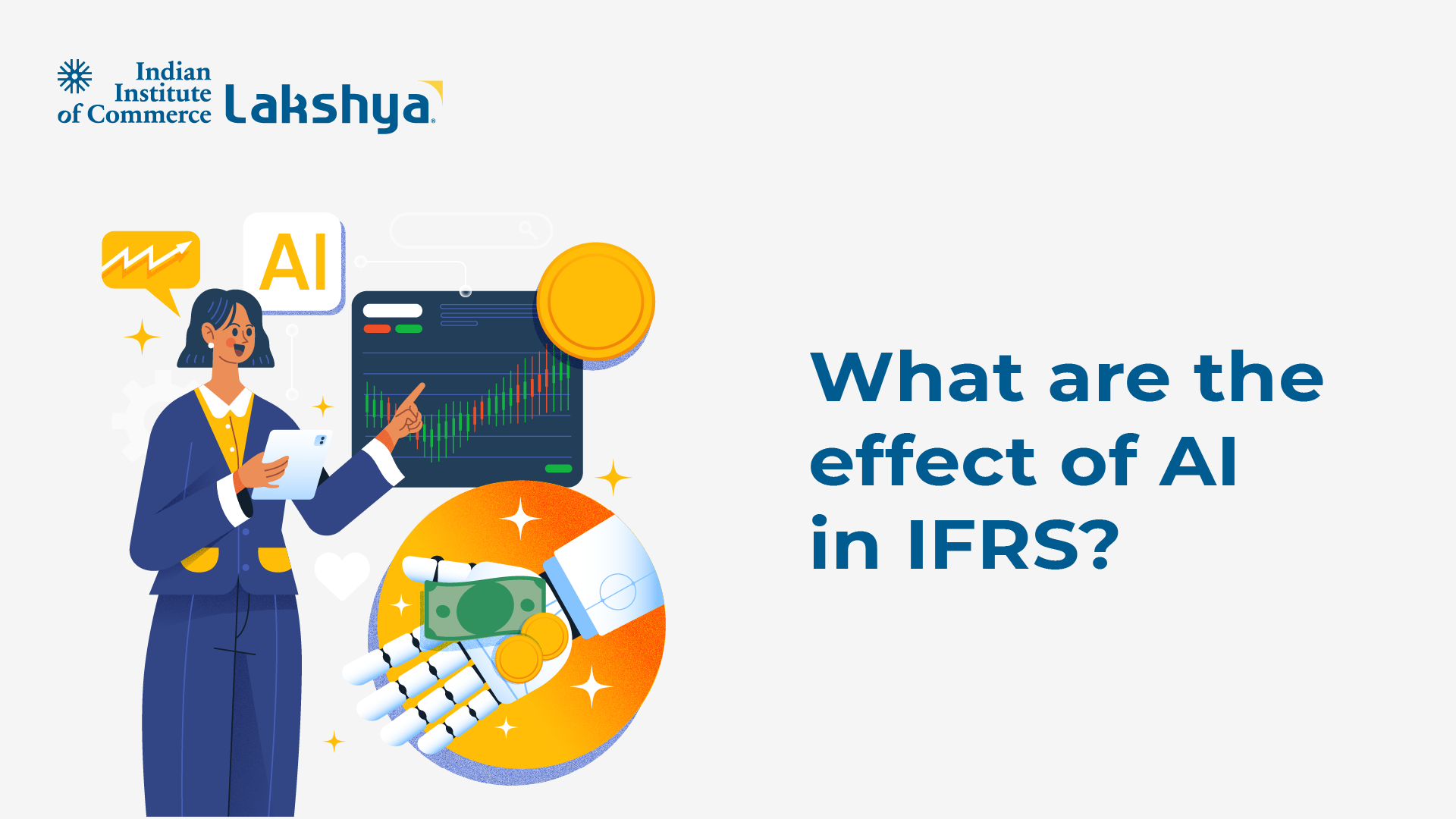
If you are a candidate or a working professional in the finance and accounting industry, learn about the International Financial Reporting Standards (IFRS). The IFRS are guidelines followed globally for financial reporting.
With the evolution of Artificial Intelligence (AI), it is becoming an integral part of IFRS. Learn about how AI influences, benefits, and risks IFRS processes here!
IFRS: Meaning & Significance
The IFRS standards are developed, established, and upheld by the IFRS Foundation. Governments and investors can comprehend financial reports produced by businesses that use IFRS, thus establishing consistency, readability, trust, and reliability. You have to explore the IFRS course & syllabus details to understand its significance in the future.
- IFRS is significant because the reporting process becomes more accurate and faster with the integration of automation.
- Companies can effectively navigate the financial fields across domestic and international markets with the implementation of IFRS Standards.
What does AI do in IFRS?
AI integrates automation in IFRS, which leads to time management and enhancement of financial reporting processes. Learn about the advantages and disadvantages of IFRS. Below are some of the steps in the implementation of AI in IFRS reflects how it brings in evolution.
- AI makes the data more organized and accurate, improving financial reporting. For example, if a large amount is missing, AI can check and track it.
- Real-time monitoring is implemented by AI automation in IFRS. Companies can monitor everything as it happens instead of waiting around for annual reports.
- IFRS is better implemented with AI machine learning; however, not everything can be decided by AI. Some situations require human management and judgement, hence human expertise is significant.
How AI Influences IFRS?
AI influences IFRS because automation helps in financial real-time monitoring, improving data reporting and resolving any gaps in manual evaluation. Below are some of how AI influences IFRS, what is IFRS, and supports the IFRS. Also, read about some AI development effects that might be risky for IFRS, hence caution is needed.
- Financial statements by AI in IFRS are accurate, hence more trustworthy
- Adjustments, delays, and mistakes are significantly reduced
- IFRS Foundations and Standards recommendations are followed closely by financial reports
- Companies are audit-ready with the implementation of AI in IFRS
- If something does not match the IFRS rules and standards, AI flags it
- Daily, companies follow the IFRS rules closely
- Human judgment is significant compared to AI implementation when it comes to estimating asset values
- Management and evaluation of handling unusual or unclear transactions is best done manually
- Deciding to recognize income should be a responsibility of the management instead of AI automation
Benefits of AI Use in IFRS
With the integration of artificial intelligence in the financial market, there have been several benefits of AI in IFRS. Also, you can also learn about the benefits of a Diploma in IFRS. Here are some of the benefits that help in overall growth, the company's functions, and operations.
- Time and money are saved with the implementation of AI in IFRS, with improved efficiency and cost reduction.
- The financial information of companies is shared in real-time as reports are easily verified and tracked.
- All IFRS reporting processes become streamlined with the implementation of AI, with audits becoming faster, systems and data are well connected.
Risks of Using AI with IFRS
There are some significant risks associated with AI implemented in IFRS processes. Below are some risks that highlight why companies, professionals, and groups still need to be cautious when using AI tools in the IFRS processing.
- There are still unclear rules related to AI learning and automation, which makes certain situations complicated for companies to function.
- AI integrates machine interpretation, which helps in recognizing patterns; however, it is not always capable of comprehending the context.
- With AI automation, handling financial transactions and data has become more difficult because of cyber attacks, data leaks, privacy laws breaches, and loss of trust.
The Future of IFRS: Use of AI with Caution
What is the future of AI integration with IFRS? AI can never replace accountants in the finance and accounting industry; however, their job profiles will go through a transformation. There are various career options and salary after Diploma in IFRS. Below are some of the aspects that must be considered when using AI in finance, and to what extent.
- Professionals will be able to save time when performing routine things
- They can focus more on problem analysis and solving
- Accounting professionals can closely collaborate with IT teams
- The IFRS Standards and rules must be updated when it comes to AI tools, the new types of data, and decisions
- Companies are also able to use clear guidance while using AI automation, while following the IFRS Standards
- IFRS Standards should evolve to make them useful and relevant
Wrapping Up!
In conclusion, AI and automation with IFRS have mostly favorable effects. Whether it is about improving data control, accuracy, and speed, AI contributes effectively to financial reporting. However, AI tools must be used effectively, and careful consideration should be given to data security and IFRS Standards update implementation.
Read More
- How to Become IFRS After 12th?
- IFRS Course Fees: 2025 Detailed Overview
- IFRS Salary Guide: India & International Benchmarks
- What is Diploma in IFRS Course?
- Diploma in IFRS ACCA Exam: Meaning, Features & Eligibility
Frequently Asked Questions on What are the effects of AI in IFRS
What are the six capitals of IFRS?
The six capitals of IFRS are manufactured, social & relationship, financial, intellectual, natural, and human.
What is IFRS 18 Replacing?
The IFRS 18 is replacing the IAS 1 Presentation of Financial Statements as the primary source of requirements in IFRS accounting standards. The IFRS 18 offers financial statement presentations that will offer better information to users.
Does India use IFRS or GAAP?
India uses Indian Accounting Standards (Ind AS), which are largely based on the International Financial Reporting Standards (IFRS). However, there are some specific modifications of Ind AS that follow GAAP or IFRS strictly. Though there is alignment with the global IFRS standards.
What is the most difficult IFRS standard?
The most difficult IFRS standard is IFRS 9 Financial Instruments, as it is one of the most challenging standards because of its complex content and exam patterns.
What are the 4 types of accounting adjustments?
The 4 types of adjustments in accounting that professionals must learn and implement in their practices are deferrals, depreciation, estimates, and accruals.
Related Course



















































_11zon.webp)























.webp)
.webp)

.webp)
.webp)
.webp)
.webp)
.webp)
.webp)
.webp)








































































































































































































































































































.webp)







































 salary.jpg)






.webp)

.webp)
.webp)