Should You Do CA with College or Focus Only on CA?
 By IIC Lakshya
 09 May 2026
 CA
CA
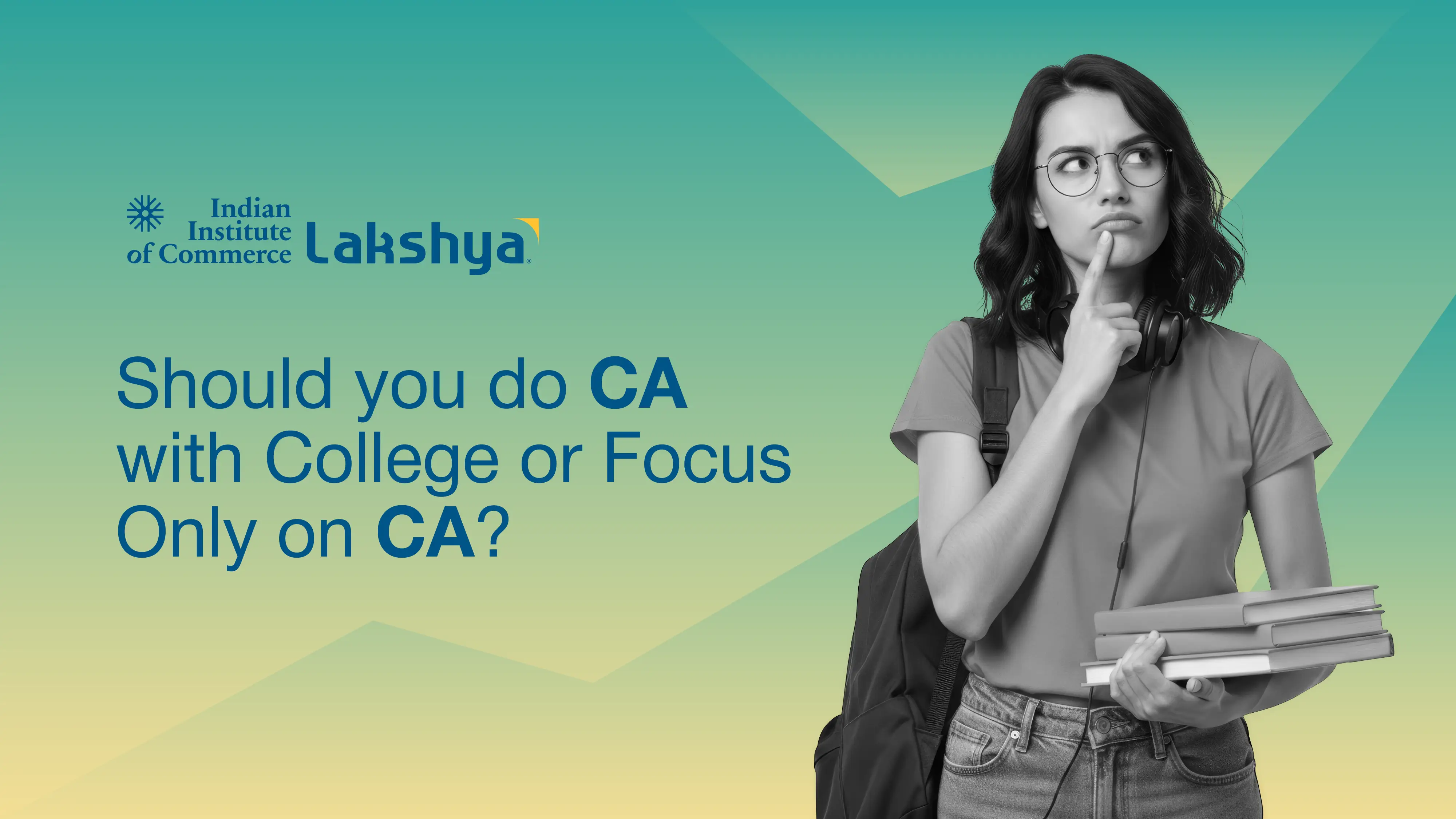
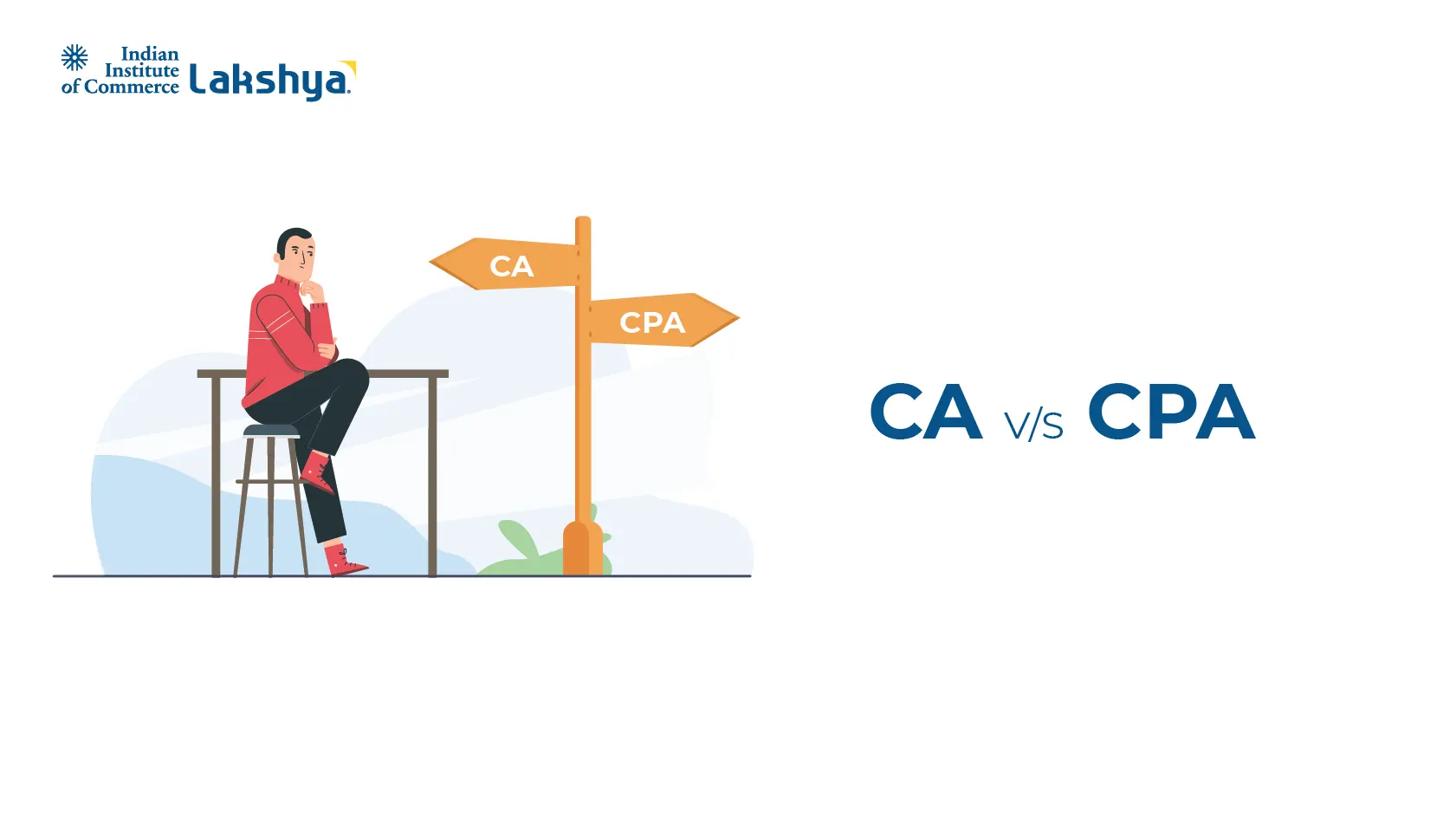
Every year, lakhs of students clear their Class 12 boards and find themselves at the same crossroads: Should I pursue CA along with a college degree, or should I put all my focus on CA alone?
It sounds like a simple question. But the answer can shape the next five to seven years of your life.
Here is the thing: there is no universal right answer for this question. What works brilliantly for one student might completely derail another. The goal of this blog is to help you figure out which path actually makes sense for you, based on where you are right now. Here in this blog, we will dig deeper into whether we have to do with CA with college or do CA alone.
How the CA Journey Works?
Before you decide anything, you need to understand the structure of the Chartered Accountancy qualification in India as set by ICAI (Institute of Chartered Accountants of India).
The CA course has three levels:
- CA Foundation: The entry point after Class 12. You need to register, complete a four-month study period, and then appear for the exam.
- CA Intermediate: After clearing Foundation (or entering via the Direct Entry route for graduates), you study two groups of papers covering subjects like Advanced Accounting, Taxation, Cost and Management Accounting, Auditing, and Law.
- CA Final: The last and most demanding level, attempted during or after your three-year articleship.
The three-year articleship is where most of the real learning happens. You train under a practising Chartered Accountant, get exposure to audits, taxation, and financial reporting, and develop the on-ground skills that exams alone can't teach.
On average, students take about 4.5 to 5 years to complete the entire CA qualification. Some finish faster; many take longer. That timeline matters when you're deciding whether to add a college degree to the mix.
Doing CA with College
A lot of students choose to pursue B.Com or BBA simultaneously with their CA preparation. Here's why this path has a lot of advantages, not just as a backup plan, but as a strategic move.
1. Your Degree Is a Safety Net You Hopefully Never Use
CA exams are brutal. The pass percentage at the Intermediate and Final levels often hovers between 10% and 20%. These are the real numbers; it's a fact you need to plan around. A graduation degree means that even if your CA journey takes longer than expected, you still hold a recognised qualification that keeps career doors open.
2. It Makes You More Attractive to Employers
Many CA aspirants don't realise this, but some corporate employers — especially in large MNCs and banking institutions — prefer or even require candidates to hold a graduation degree alongside their CA. Having both can give you a stronger profile when you enter the job market after qualification.
3. B.Com Syllabus Actually Overlaps with CA
This is the underrated advantage of combining B.Com with CA. Subjects like Financial Accounting, Business Law, Economics, and Taxation appear in both. The conceptual overlap means your college studies can reinforce your CA preparation, not compete with it. Many students find that studying for B.Com exams helps them revise CA Foundation and Intermediate concepts organically.
4. The College Experience Has Real-World Value
Networking, communication, team projects, and personality development are the things CA coaching classes don't cover. A few years on a college campus can build confidence and social skills that make you a better professional, not just a better accountant.
Focusing Only on CA
Now, let’s discuss the case where the users will only focus on CA:
1. CA Is an Extremely Demanding Course
This is not an exaggeration. CA Intermediate and Final papers demand hundreds of hours of dedicated preparation. Students who try to manage college attendance, assignments, and internal exams alongside CA coaching often end up doing justice to neither. The mental bandwidth is simply stretched too thin.
2. Your Articleship Leaves Very Little Time
Once your three-year articleship begins, your daily schedule is largely set by your principal's firm. Most articleship students work from 9 AM to 6 PM, sometimes longer during peak audit seasons. Adding college attendance requirements on top of this, with attendance minimums that many universities strictly enforce, creates a scheduling nightmare.
3. Attempts Add Up Quickly
Every failed attempt at CA Intermediate or Final costs you six months. If you are also managing college stress and exams during that time, your focus is divided exactly when you need it most. Students who go all-in on CA, particularly during the Foundation and early Intermediate phase, tend to clear papers in fewer attempts, which saves time and money.
4. The Direct Entry Route Is an Option
If you have already completed graduation (B.Com with 55% or another stream with 60%), ICAI's Direct Entry route allows you to skip CA Foundation entirely and start directly at the Intermediate level. If you're genuinely unsure, completing your graduation first and then entering CA through the direct route is also a legitimate strategy.
So Which One Should You Choose? Here's a Practical Framework
Rather than giving you a one-size-fits-all answer, here's a way to think through this for your specific situation.
Choose CA with College if:
- You can secure admission to a college that offers flexible or open-book exams (some universities in India offer this specifically for CA students)
- You're enrolling in a college that has distance education or correspondence options recognised by your state
- Your family situation requires you to hold a degree as a fallback
- You're a student who performs well under pressure and can manage multiple academic streams simultaneously
- You want to pursue an MBA or other postgraduate degree later, which typically requires a graduation certificate
Choose CA Only if:
- You are fully committed to the CA path and have no interest in pursuing higher education in a traditional academic setting
- You have seen your own track record and know you focus better without splitting your energy
- You have strong support from family and have already mapped out your articleship plan
- You're in a city or town where quality CA coaching is available, but college options are limited or of poor quality
- You want to clear CA as fast as possible and enter the workforce earlier
The Option Most Students Overlook: Distance or Correspondence Graduation
Here is something many CA aspirants don't fully explore: distance education graduation from IGNOU or state open universities is fully valid for most corporate employers and for government job eligibility.
IGNOU's B.Com programme, for instance, has no mandatory attendance requirements, costs a fraction of regular college fees, and can be completed at your own pace. Many successful Chartered Accountants have completed their graduation through IGNOU simultaneously with their CA journey, without any of the scheduling conflicts that regular college attendance creates.
If the debate is specifically about regular college attendance versus CA focus, IGNOU-style distance education is often the middle ground that solves the problem entirely.
What Toppers and Successful CAs Actually Say?
Talk to CAs who cleared in the first or second attempt, and you'll notice a pattern. Most of them, regardless of whether they did college alongside CA or not, have one thing in common: they were ruthlessly clear about their priority at any given point in time.
When they were preparing for Intermediate, CA was the priority. When they were doing articleship, skill development was the priority. The ones who struggled most were typically the ones who were always trying to do everything at the same time without a clear hierarchy of focus.
The degree or no-degree question matters less than the question: Do you know what your primary focus is right now, and are you protecting it?
A Quick Word on Parents and Family Expectations
In many Indian households, not going to college feels like an unusual or risky choice, even if the alternative is pursuing CA. If that pressure exists in your home, having an open conversation about the career trajectory of a CA, the earning potential, the respect in the profession, and the structured learning through articleship can help ease those concerns.
Alternatively, the distance education route often satisfies the "you have a degree" requirement while keeping your CA preparation on track. It's worth exploring this with your family together.
Conclusion
Doing CA with regular college works well if your college setup supports it, which means flexible exams, manageable attendance, and a syllabus that overlaps with CA content. B.Com from a college with CA-friendly policies, or a correspondence degree, can genuinely complement your CA preparation rather than compete with it.
Focusing only on CA works well if you're deeply committed, self-disciplined, and have thought through your financial and career contingency plan in case the CA journey takes longer than expected.
There is no wrong choice here; that's only an uninformed one. Make your decision based on your own schedule, your learning style, your family situation, and a realistic understanding of how demanding both the CA course and college commitments actually are.
Whatever you choose, choose it fully. Half-hearted attempts at both will cost you far more than a clear decision in either direction.
Related Course











_11zon.webp)






.webp)
.webp)

.webp)
.webp)
.webp)
.webp)
.webp)
.webp)
.webp)



































.webp)


 salary.jpg)

.webp)

.webp)
.webp)