Is CA Difficult For the Non-Commerce Students?
 By IIC Lakshya
 09 May 2026
 CA
CA
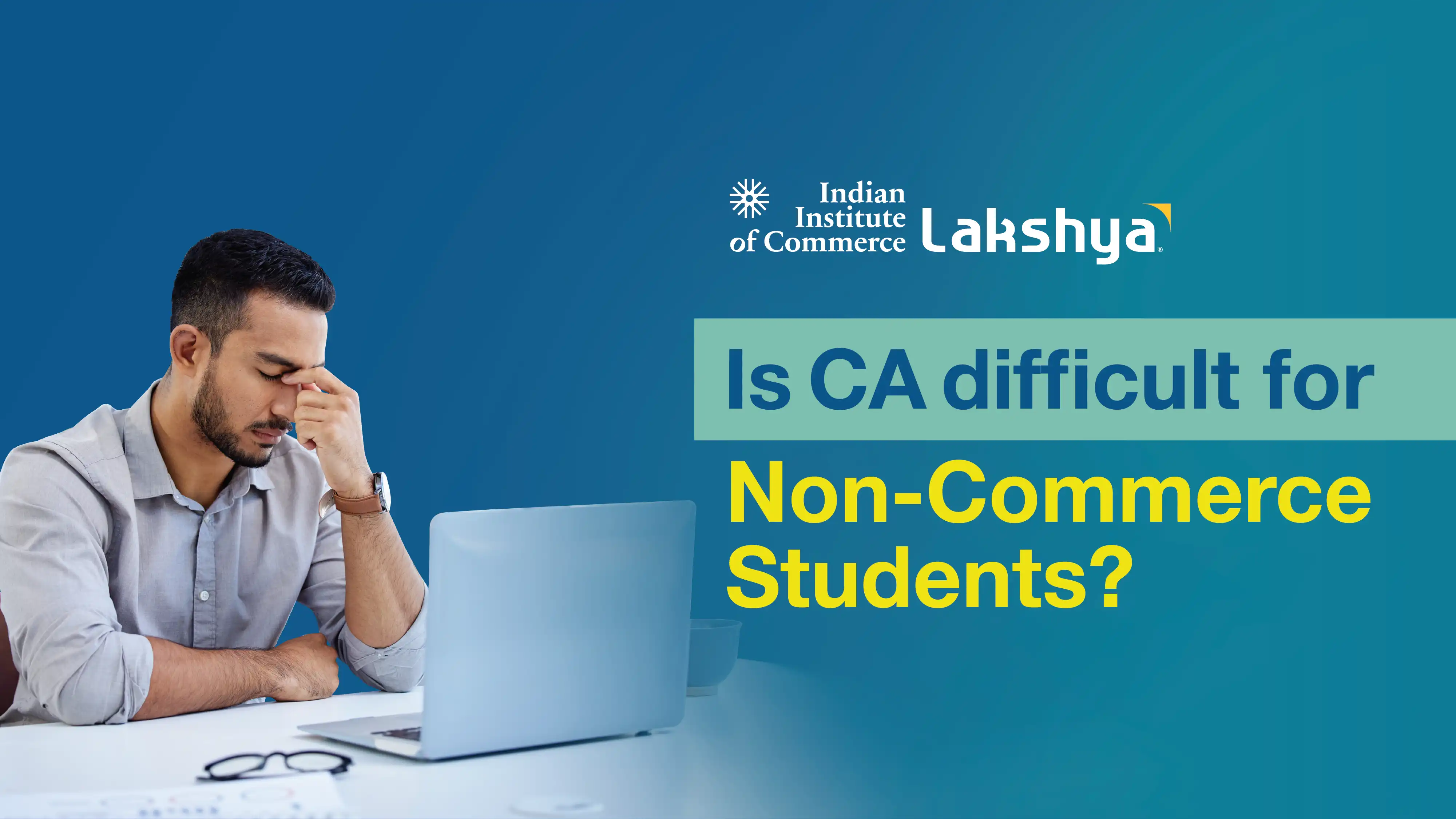
You have probably already read many motivation articles that say things like "CA is open to all streams!" and "Passion is all you need!" and then give you zero practical information about what actually happens when a Science or Arts student walks into CA Foundation.
So here's the most common question that is asked by the users: Is CA Hard for non-commerce students?
The answer is CA is challenging at first, but in the long run, it is more beneficial in terms of growth opportunities.
The Chartered Accountancy path is demanding for all candidates, regardless of their previous academic focus. With Final level pass percentages often remaining in the single digits, even commerce students who have focused on accounting since Class 11 frequently struggle to pass on their initial try.
"Which particular hurdles will I encounter while preparing for CA from a non-commerce background, and what is the strategy for overcoming them?"
These inquiries lead to different outcomes. While one offers a comforting perspective, the other provides the practical guidance necessary for success.
The Reality for Non-Commerce Students Entering CA Preparation
Standard commerce students arrive at the CA Foundation level with a two-year head start in Accountancy, Economics, and Business Studies, making balance sheets and journal entries second nature to them.
For those from a non-commerce background, this initial lack of exposure creates a significant knowledge gap. This disparity is most evident during the first few months of Foundation study in several key areas:
- Complex Accountancy Topics: Accountancy Concepts such as debits, credits, and ledgers are not naturally intuitive. While commerce students have built muscle memory over the years, you are starting from scratch while balancing exam preparation, which requires more intense effort early on.
- Developing Commercial Intuition: CA questions are rooted in business contexts, such as corporate transactions and disputes, that commerce students absorb unconsciously. Science or Arts students must actively work to build this business awareness.
- Handling Conceptual Volume: The sheer amount of new information in subjects like Business Laws and Accountancy can be overwhelming. While Science students may find Quantitative Aptitude familiar, the rest of the curriculum is often entirely new territory.
The goal is to provide an accurate preview of the CA journey for the non-commerce background, so you can prepare effectively for the challenges ahead in your CA exam preparation.
By the time a commerce student reaches the CA Foundation stage, they have already built a solid two-year background in core subjects like Economics, Business Studies, and Accountancy. Concepts such as balance sheets and journal entries are familiar territory for them.
As a non-commerce student, you lack this prior exposure.
This creates a genuine knowledge gap that becomes most apparent during the initial months of the CA Foundation. The disparity typically manifests in the following ways:
- Accountancy feels like a foreign language initially. Debits, credits, ledgers, and trial balances — these aren't intuitive concepts. Commerce students have had two years of muscle memory with these. You're building that understanding from zero while simultaneously preparing for an exam. It takes longer and requires more deliberate effort in the early weeks.
- Business and commercial awareness takes time to develop. Questions in CA aren't just theoretical. They're set in business contexts — companies, transactions, disputes, decisions. Commerce students absorb this context almost unconsciously over two years. For Science or Arts students, that commercial intuition has to be actively built.
- The volume of new concepts hits harder. CA Foundation covers Accountancy, Business Laws, Quantitative Aptitude, and Business Economics. For a Science student, Quantitative Aptitude feels familiar. For an Arts student, it might not. For everyone outside commerce, Business Laws and Accountancy are genuinely new territory, and there's a lot of it.
None of this is meant to discourage you. It's meant to make sure you go in with an accurate picture rather than a pleasant surprise that turns into an unpleasant one.
Where Non-Commerce Students Actually Have an Edge?
- Science students are trained to handle complex Problems. If you have cleared Physics and Maths at Class 12 level, you have already proven something: you can sit with a concept you don't understand, work through it methodically, and arrive at the right answer. CA rewards exactly this kind of thinking, especially at higher levels where problems require multi-step reasoning.
- Arts students are often stronger communicators. CA isn't just numbers. Strategic Business Management, Law papers, and the communication components of practical training all require the ability to read, interpret, and write clearly. Many commerce students underestimate this side of CA. Arts students often don't.
- Starting fresh means no bad habits. This sounds like consolation, but it's more than that. Many commerce students arrive with shortcuts, half-understood concepts, and assumptions baked in from two years of school-level study. Non-commerce students build their understanding of accountancy the way it's actually supposed to work, from first principles. When that foundation is built correctly, it tends to be more durable.
- Adaptability is already proven. Choosing CA from a Science or Arts background is itself an act of deliberate decision-making. Students who make unconventional choices and commit to them tend to be more self-directed than those who follow a standard path. Self-direction matters enormously in CA because nobody is going to chase you through three levels of exams over several years.
The Subjects That Need Extra Attention for the non-commerce students
If you're a non-commerce student planning CA, these are the areas worth investing in early, before you feel the pressure of deadlines:
- Accountancy (CA Foundation and Intermediate): Don't try to memorise your way through this. The students who struggle most are the ones who learn journal entries like a list of rules rather than understanding the logic behind them. Spend the first few weeks just understanding the fundamental equation, Assets = Liabilities + Equity, and why every transaction affects it the way it does. Everything else builds from there.
- Corporate and Business Laws: This is heavy reading, and it rewards students who approach it like a story rather than a statute. Laws exist because something went wrong. Understanding why a law exists makes it far easier to remember and apply than trying to memorise sections in isolation.
- Taxation (at Intermediate and Final): Indian taxation, both direct and indirect, is genuinely complex and changes regularly. Non-commerce students often find it challenging because there's no prior exposure, but it's also one of the most learnable subjects in CA when taught well. The logic is consistent once you understand the structure.
What Actually Determines Whether You Make It?
After all the stream comparisons and subject breakdowns, the reality is that stream background explains very little about who clears CA and who doesn't.
What actually determines it:
- How early you start building foundational concepts. Students who hit CA Foundation, having already spent two or three months getting comfortable with basic accountancy and business law, carry a significant advantage, regardless of whether they came from commerce, science, or arts.
- Whether you seek help quickly when you're lost. CA has a way of compounding confusion. One concept you don't understand leads to struggling with the next one that builds on it. Students who flag confusion early, with teachers, peers, or coaching, consistently do better than those who push through and hope it clicks later.
- Consistency over intensity. CA is a long exam. Burning out in month two of a three-year journey is a common pattern for students who treat preparation like a sprint. Students who pace themselves, show up regularly, and review consistently tend to outlast the ones who go hard for short bursts and then disappear.
The Practical Verdict
Non-commerce students can absolutely clear CA, and many have, at impressive ranks. The Foundation level requires extra groundwork in accountancy and business subjects, but that gap closes faster than most people expect with structured preparation.
The challenges are real, specific, and manageable. The advantages are also real, specific, and frequently underestimated.
What neither helps nor hurts you: which stream you studied in Class 12.
What actually matters: whether you're willing to build from scratch, ask for help when you need it, and keep going on the days when it gets genuinely hard, which at some point it will be for everyone.
One Last Thing
Your CA foundation, the depth of understanding you build in the early stages, determines how far the qualification takes you. Not just whether you pass, but what kind of professional you become on the other side.
Lakshya works with CA students at every level, including those coming from non-commerce backgrounds, to build the kind of real conceptual understanding that holds up under exam pressure and in actual professional practice.
If you're starting from outside commerce and want to do this properly, reach out to Lakshya. The right start makes the entire journey different.
Related Course






































_11zon.webp)













.webp)
.webp)

.webp)
.webp)
.webp)
.webp)
.webp)
.webp)
.webp)

















































































































.webp)












 salary.jpg)



.webp)

.webp)
.webp)